By Ethiopian BeansFeb 11, 202611 min read
Ethiopian Coffee History: The Birthplace of Coffee
Key Takeaway
Coffee originated in the forests of southwestern Ethiopia over a thousand years ago. From there it spread to Yemen, the Ottoman Empire, Europe, and eventually every continent. Ethiopia remains the only country where coffee grows wild in its natural habitat, and its heirloom varieties produce flavour complexity that no other origin can replicate. Understanding this history explains why Ethiopian coffee tastes different from everything else in your cup.
Ethiopian coffee history begins long before plantations, brands, or brewing gadgets existed. The coffee plant, Coffea arabica, evolved in the cool highland forests of southwestern Ethiopia. For centuries, local communities consumed coffee as food, medicine, and sacred ritual before anyone thought to roast and brew the seeds. Every cup of coffee you drink today traces its genetic ancestry back to these forests.
This article covers the full arc: from the legendary discovery in the Kaffa region to the global trade routes that made coffee the world's second most traded commodity. More importantly, it connects that history to the Ethiopian coffee you can buy and brew right now.
The Legend of Kaldi and the Discovery of Coffee
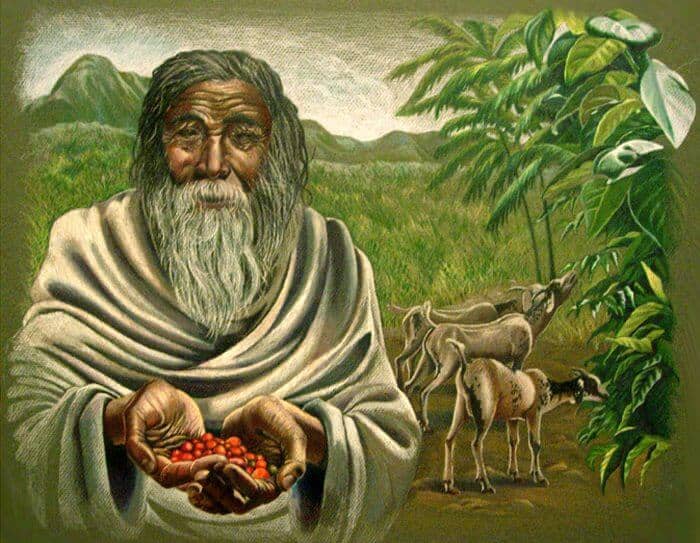
The most famous origin story centres on Kaldi, a young goat herder in the Ethiopian highlands. According to the legend, Kaldi noticed his goats became unusually energetic after eating red berries from a certain tree. Curious, he tried the berries himself and felt a similar surge of alertness. He brought the berries to a local monastery, where a monk dismissed them as the work of the devil and threw them into a fire.
The roasting beans released an irresistible aroma. The monks retrieved them from the fire, crushed them, and dissolved the grounds in hot water. The resulting drink kept them awake through long hours of evening prayer. Word spread, and the practice of drinking coffee began.
Historians date the Kaldi legend to around the 9th century, though the earliest written account appeared much later in a 17th-century manuscript. Whether Kaldi was a real person or a folk invention, the core fact stands: the coffee plant is indigenous to Ethiopia, and Ethiopian communities were the first to recognize its stimulating properties. Genetic research published by the World Coffee Research organization confirms that all commercial Arabica coffee descends from Ethiopian wild populations.
Before the Brew: How Ethiopians First Used Coffee
Long before anyone brewed coffee as a drink, Ethiopian communities used the plant in ways that would surprise most modern coffee lovers.
Coffee as Food
Several ethnic groups in southwestern Ethiopia ground raw coffee beans, mixed them with animal fat (usually butter or ghee), and formed the paste into small balls. These high-energy snacks sustained herders and travellers on long journeys. The Oromo people are most closely associated with this practice, and some communities in the Kaffa and Jimma zones continue it today.
Coffee Cherry Tea (Qishr)
The outer fruit of the coffee cherry was also steeped in hot water to create a tea-like drink. This preparation, known as qishr (or hashara in some Ethiopian languages), predates the roasted-bean method. The dried coffee cherry husks produce a sweet, fruity infusion that tastes nothing like brewed coffee but carries a mild caffeine boost.
Spiritual and Social Ritual
Coffee quickly became embedded in Ethiopian spiritual life. Sufi monks in the Harar region are credited with popularizing coffee as a drink to aid concentration during prayer. Over time, coffee preparation evolved into the Ethiopian coffee ceremony (buna tetu), a communal ritual that remains central to Ethiopian social life. The ceremony involves roasting green beans over charcoal, grinding them by hand, and brewing in a jebena (clay pot), all performed in front of guests as an act of hospitality.
How Coffee Spread from Ethiopia to the World
The journey of coffee from Ethiopian forest to global commodity took several centuries and crossed multiple empires.
Ethiopia to Yemen (15th Century)
Coffee crossed the Red Sea to Yemen sometime in the 15th century, carried by traders or Sufi pilgrims. Yemeni farmers were the first to cultivate coffee as a crop, planting it on terraced hillsides near the port city of Mocha (al-Mukha). The name "mocha" in coffee culture traces directly to this Yemeni port. Yemeni Sufis used coffee extensively to stay awake for nighttime devotions, and the drink spread through the Islamic world along trade and pilgrimage routes. Despite sharing the same genetic roots, Ethiopian and Yemeni coffees developed distinct flavour identities over the centuries; our Ethiopian vs Yemeni coffee comparison explores exactly how and why they diverged.
The Ottoman Empire and the Rise of Coffeehouses (16th Century)
By the early 1500s, coffee had reached Cairo, Damascus, and Istanbul. The Ottoman Empire embraced the drink enthusiastically. Coffeehouses (kahvehane) became social and intellectual centres, sometimes called "schools of the wise." Ottoman authorities periodically banned coffee, fearing that coffeehouses encouraged political dissent, but the bans never lasted. Coffee was too popular.
The Ottomans closely guarded their supply. They exported only roasted or partially boiled beans to prevent cultivation outside their territories. This monopoly held for over a century.
Coffee Reaches Europe (17th Century)
European travellers and merchants encountered coffee in the Middle East and brought it home. The first European coffeehouse opened in Venice in 1645. London followed in 1652, and Paris in 1672. European elites initially debated whether coffee was a "Muslim drink" and sought papal approval. Pope Clement VIII reportedly tasted it, approved, and allegedly said it would be a sin to leave such a drink to non-Christians alone.
Coffeehouses reshaped European commerce and culture. Lloyd's of London began as a coffeehouse. The London Stock Exchange grew from coffeehouse trading. The French Enlightenment was fuelled, in part, by Parisian coffee culture.
Colonial Plantations and Global Expansion (18th-19th Century)
The Dutch broke the Ottoman monopoly by smuggling coffee seedlings out of Yemen in the late 1600s. They established plantations in Java (Indonesia), then Ceylon (Sri Lanka), and eventually the Caribbean. The French planted coffee in Martinique and Haiti. The Portuguese brought it to Brazil, which would become the world's largest producer by the 1800s.
All of these plantations began with a tiny genetic base: a handful of plants descended from Ethiopian wild coffee, filtered through Yemeni cultivation. This genetic bottleneck explains why coffee from Brazil, Colombia, or Central America shares a narrower flavour range than Ethiopian coffee, which retains thousands of wild and semi-wild varieties.
A Timeline of Ethiopian Coffee History
This timeline highlights the major milestones from discovery to modern trade.
| Period | Event |
|---|---|
| ~9th century | Legend of Kaldi; coffee berries first consumed in Ethiopia's Kaffa region |
| 10th-14th century | Coffee used as food (ground beans with fat) and qishr tea by Oromo and other groups |
| 15th century | Coffee crosses the Red Sea to Yemen; first cultivated as a crop near Mocha (al-Mukha) |
| Early 1500s | Coffee spreads through the Ottoman Empire; coffeehouses open in Cairo, Damascus, Istanbul |
| 1645 | First European coffeehouse opens in Venice |
| Late 1600s | Dutch smuggle coffee seedlings from Yemen; plantations established in Java |
| 1700s | Coffee plantations spread to Caribbean, Central America, South America |
| 1800s | Brazil becomes the world's largest coffee producer; Ethiopia remains a local and regional exporter |
| 1950s-1970s | Ethiopian government formalizes coffee grading and export systems |
| 2008 | Ethiopian Commodity Exchange (ECX) established; centralizes coffee trading |
| 2020s | Direct trade and specialty micro-lots gain momentum; Ethiopia exports to over 50 countries |
Ethiopia's Coffee Regions: Where History Grows Today
The same highlands where coffee was first discovered still produce some of the world's most sought-after beans. Each region carries its own microclimate, soil composition, and heirloom varieties, producing distinct flavour profiles that reflect centuries of natural selection.
Grown at 1,700 to 2,200 metres in the Gedeo zone. Known for jasmine, bergamot, and lemon notes. Washed Yirgacheffe is one of the most recognizable specialty coffees in the world.
A newer designation south of Sidamo, producing natural and washed lots with intense blueberry, tropical fruit, and dark chocolate character. Guji has become a favourite among specialty roasters in the past decade.
One of Ethiopia's largest and most diverse growing areas. Sidamo coffees range from bright and citrusy (washed) to heavy and berry-forward (natural), depending on altitude and processing.
The oldest known coffee-growing region outside Kaffa, located in eastern Ethiopia. Harar coffee is dry-processed and famous for its wild, wine-like, blueberry flavour. The city of Harar itself is one of the earliest centres of Sufi coffee drinking.
Grown in western Ethiopia at 1,400 to 2,000 metres. Limu produces washed coffees with a rounded, wine-like acidity and spicy, floral undertones. Less famous internationally, but highly regarded by those who know it.
For help choosing between these regions based on your taste preferences, see our buyer's guide to Ethiopian coffee.
The Ethiopian Commodity Exchange and Modern Coffee Trade
For most of the 20th century, Ethiopian coffee was traded through a fragmented system of brokers, regional auctions, and government agencies. Quality control was inconsistent, and traceability was limited. A farmer in Yirgacheffe had little visibility into where their beans ended up or what price they ultimately fetched.
In 2008, the Ethiopian government launched the Ethiopian Commodity Exchange (ECX) to modernize the system. The ECX introduced standardized grading, warehouse receipts, and electronic trading. All coffee had to pass through the exchange, which improved transparency and reduced fraud but initially made it harder to trace beans back to specific farms or cooperatives.
In recent years, the Ethiopian government has loosened ECX requirements to allow direct trade for specialty-grade lots. This shift enables exporters to work with specific cooperatives and washing stations, preserving traceability and rewarding quality. According to the International Coffee Organization (ICO), Ethiopia is now Africa's largest coffee producer and the world's fifth largest, exporting over 250,000 metric tons annually.
Direct relationships between exporters and international buyers mean that Canadian consumers can now access single-origin lots with full traceability: the specific region, washing station, altitude, and processing method. This level of detail was impossible under the old system.
Why Ethiopian Coffee Remains Genetically Unique
Here is a fact that changes how you think about your morning cup: Ethiopia is home to an estimated 6,000 to 10,000 distinct varieties of Arabica coffee. Most other coffee-producing countries work with fewer than a dozen cultivars, all descended from a tiny genetic sample that left Ethiopia centuries ago.
This genetic diversity is not just a botanical curiosity. It directly affects flavour. Ethiopian heirloom varieties produce a wider spectrum of tasting notes (jasmine, bergamot, blueberry, peach, chocolate, wine, tropical fruit) than coffee from any other single country. When you compare Ethiopian coffee to Colombian coffee or Ethiopian coffee to Kenyan coffee, what you are really comparing is genetic depth versus genetic narrowness.
Climate change makes Ethiopian genetic diversity even more critical. Wild coffee populations in Ethiopian forests are a reservoir of disease resistance, drought tolerance, and flavour potential that breeders worldwide depend on. Protecting these forests is not only an environmental issue; it is a matter of global coffee security.
What Ethiopian Coffee History Means for Your Cup
History is not just background information. It explains why Ethiopian coffee tastes the way it does. The wild genetic diversity of the forests, the altitude and soil of the highlands, the centuries of traditional processing, and the recent shift toward traceable specialty trade all contribute to what ends up in your grinder and cup.
Coffee that grows where it evolved is different from coffee transplanted to foreign soil and managed for yield. Ethiopian farms and forest gardens operate at altitudes between 1,400 and 2,200 metres, where cool nights slow cherry maturation and concentrate sugars and organic acids. This is why Ethiopian tasting notes tend toward bright, complex, and layered rather than simple and one-dimensional.
If you are new to Ethiopian coffee, you are stepping into a tradition that predates every other coffee culture on earth. The same forests, the same communities, and many of the same farming practices that produced the first cups of coffee are still active today. That continuity is something no other origin can claim.
Frequently Asked Questions
Is Ethiopia the birthplace of coffee?
Yes. All Arabica coffee (Coffea arabica) traces its genetic origin to the highland forests of southwestern Ethiopia. Coffee grows wild there to this day, and genetic studies confirm it is the only place where the species evolved naturally before human cultivation began.
How was coffee discovered in Ethiopia?
The most widely told story involves a goat herder named Kaldi who noticed his goats became energetic after eating red coffee berries. He brought the berries to a monastery, where monks brewed them and discovered the stimulating effect. Historians date this legend to around the 9th century.
When did coffee spread from Ethiopia to the rest of the world?
Coffee moved from Ethiopia to Yemen in the 15th century, reached the Ottoman Empire by the early 1500s, and arrived in Europe in the mid-1600s. The Dutch established the first colonial coffee plantations in Java in the late 1600s, and Brazil became a major producer by the 1800s.
Why does Ethiopian coffee taste different from other origins?
Ethiopia has 6,000 to 10,000 distinct Arabica varieties, compared to fewer than a dozen in most producing countries. This genetic diversity, combined with high-altitude growing conditions and traditional processing, creates a wider range of flavour notes than any other single origin.
What is the Ethiopian coffee ceremony?
The Ethiopian coffee ceremony (buna tetu) is a social ritual of roasting green beans, grinding by hand, and brewing in a clay pot called a jebena. It includes three rounds of coffee served with incense and often snacks. The ceremony remains a cornerstone of Ethiopian hospitality and daily life.
Conclusion: The Story in Every Cup
Ethiopian coffee history is not a marketing angle or a branding exercise. It is the factual origin of every coffee bean on earth. The forests where Coffea arabica evolved still stand. The communities that first roasted and brewed coffee still practice those traditions. The genetic diversity that gives Ethiopian coffee its extraordinary range of flavours is still growing, wild and cultivated, across the highlands.
Every cup of Ethiopian coffee connects you to that lineage. The jasmine in a washed Yirgacheffe, the blueberry in a natural Guji, the wine-like depth in a Harar: these flavours exist because of a thousand years of natural and human history working together. Knowing that story makes the coffee taste better, or at least, it should.
Specialty Ethiopian Coffee, Sourced Through Our Own Export Company
Every bag we sell comes directly from Ethiopian farms through our family export company, Ethio Coffee Export. You get full traceability, freshness, and the authentic flavour of coffee from its birthplace.
Taste the origin for yourself.
Related Articles
Culture and Origins
Flavour and Comparison
Buying and Regions
About This Insight: Written by Ethiopian Beans, a Canadian coffee company sourcing exclusively through our family export company Ethio Coffee Export in Ethiopia. Historical claims are based on widely accepted scholarship and cited sources. For current product availability and sourcing details, please contact us.