By Ethiopian BeansJan 25, 202611 min read
Ethiopian Coffee Tasting Notes Explained
Key Takeaway
Ethiopian coffee tasting notes like "blueberry," "jasmine," and "bergamot" describe real flavour compounds in the bean, not added ingredients. Each Ethiopian growing region produces a distinct flavour profile. Learning to identify these notes takes practice, not talent. A simple home cupping method with two cups of different regions is the fastest way to train your palate.
The bag says "notes of blueberry, dark chocolate, and jasmine." You brew a cup, take a sip, and taste... coffee. Maybe good coffee. But blueberry? Jasmine? It can feel like the roaster is making things up.
They are not. Ethiopian coffee contains measurable concentrations of the same aromatic compounds found in berries, flowers, citrus fruits, and chocolate. The challenge is not that the flavours are absent. The challenge is that most of us have never been taught how to isolate and name what we taste. We process coffee as one single flavour instead of a combination of many.
This guide explains what Ethiopian coffee tasting notes actually mean, what drives them, and how to start recognizing them in your own cup. No special equipment or training is required. If you can tell the difference between an orange and a lemon, you can learn to taste the difference between a Yirgacheffe and a Guji. New to Ethiopian coffee entirely? Our beginner's guide covers which region and roast to try first.
Before you train your palate, make sure your beans are still fresh. Use our Ethiopian coffee storage guide for Canada to avoid flavour loss caused by heat, humidity, and repeated bag opening.
Wondering how Ethiopian tasting notes compare to another famous African origin? Our Ethiopian vs Kenyan coffee comparison breaks down the flavour, acidity, and body differences side by side.
What Are Coffee Tasting Notes?
Tasting notes are descriptive labels that professional cuppers and roasters use to communicate a coffee's flavour profile. They are reference points, not recipes. When a bag says "blueberry," it means the coffee contains aromatic compounds that your brain associates with blueberry. Nobody has added blueberry flavouring to the beans.
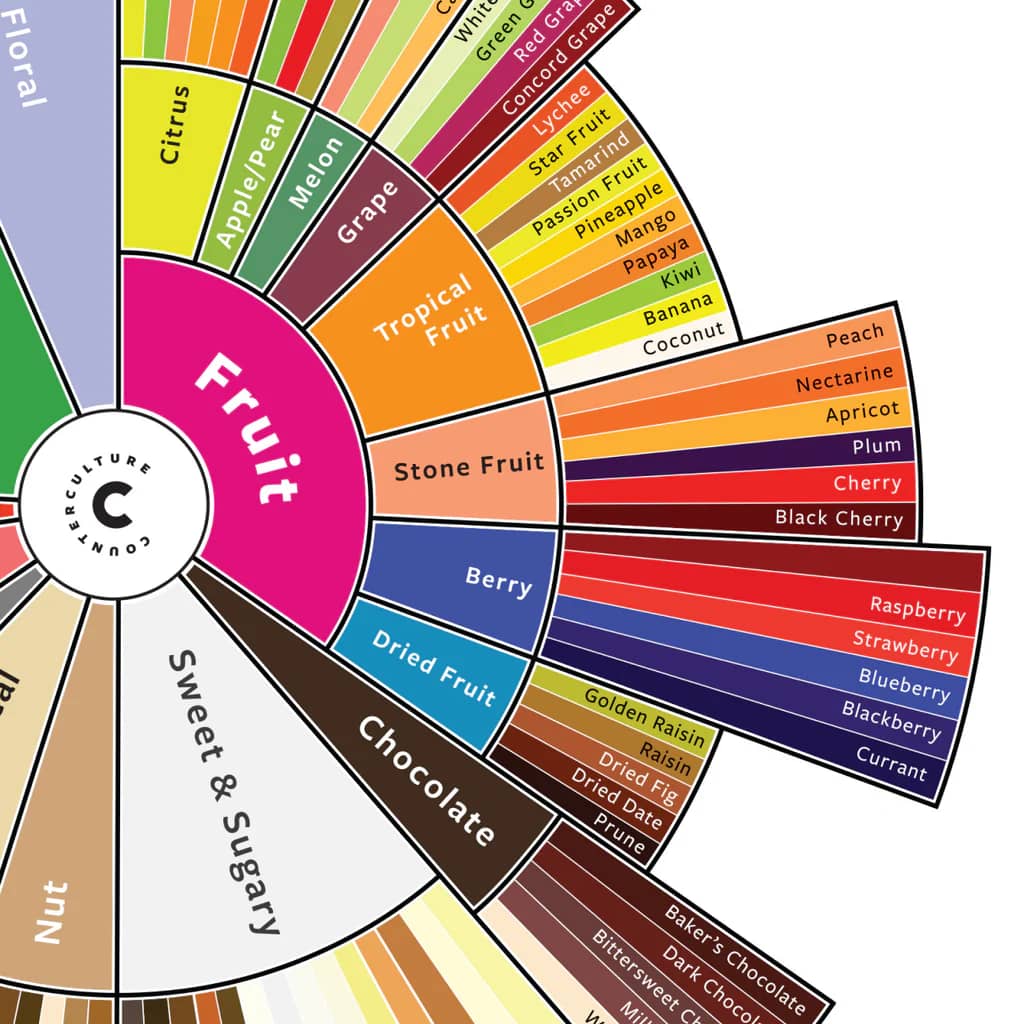
The Specialty Coffee Association (SCA) Flavour Wheel is the industry standard reference. It organizes coffee flavours into categories: fruity, floral, sweet, nutty, spicy, roasted, and others. Ethiopian coffees tend to cluster heavily in the fruity and floral sections, which is one reason they stand out from coffees grown in Central America or Southeast Asia.
Three main factors shape the tasting notes you will find in Ethiopian coffee:
- Genetics. Ethiopia is home to thousands of indigenous Arabica varieties, many never formally catalogued. This genetic diversity produces a wider range of flavour compounds than any other coffee origin.
- Terroir. Altitude, soil composition, rainfall, and microclimate vary dramatically between Ethiopian regions. Yirgacheffe sits at 1,700 to 2,200 metres above sea level; Harar grows between 1,500 and 2,100 metres but in a much drier climate. The bean absorbs its environment.
- Processing. Whether the coffee is washed or natural changes the flavour profile significantly. Washed beans tend toward clean, bright, floral notes. Natural beans lean toward heavy, fruity, sometimes wine-like character.
Ethiopian Coffee Tasting Notes by Region
Each Ethiopian growing region has a recognizable flavour signature. Once you have tasted two or three, you will start to identify them even before checking the label. For a complete side-by-side comparison of all five regions with altitude, body, acidity, and brewing pairings, see our Ethiopian coffee regions compared guide.
Yirgacheffe
Yirgacheffe is the most famous Ethiopian coffee region for a reason. Washed Yirgacheffe delivers jasmine, bergamot (the citrus oil in Earl Grey tea), lemon zest, and a delicate tea-like body. Natural Yirgacheffe adds tropical fruit and strawberry to the mix, with a heavier mouthfeel. The defining quality is brightness: a clean, sparkling acidity that lifts every sip.
Look for: Jasmine, bergamot, lemon, peach, black tea.
Sidamo
Sidamo coffees are fruit-forward with a rounder, softer acidity than Yirgacheffe. Expect berry notes (blueberry, raspberry), stone fruit (apricot, plum), and a wine-like sweetness. Naturals from Sidamo can taste almost like berry jam spread on toast. The body is medium, and the finish tends to be sweet and lingering.
Look for: Blueberry, raspberry, apricot, red wine, brown sugar.
Guji
Guji is a newer specialty region that has gained serious attention over the past decade. These coffees are bold and complex, often combining bright fruit (blueberry, mango, passion fruit) with deeper undertones of dark chocolate and spice. Guji naturals can be intensely fruity; Guji washed coffees are cleaner but still carry more weight than a typical Yirgacheffe.
Look for: Blueberry, mango, dark chocolate, cinnamon, tropical fruit.
Harar
Harar is one of the oldest coffee regions in the world and produces almost exclusively natural-processed beans. The flavour profile is wild and distinctive: heavy blueberry, dark chocolate, dried fruit, and a fermented wine-like quality that no other origin replicates quite the same way. Harar is polarizing. People who love it tend to rank it among their all-time favourites.
Look for: Blueberry, dark chocolate, dried fig, wine, tobacco.
Limu
Limu is less well-known but produces consistently pleasant, balanced coffee. Think mild acidity, sweet spice (nutmeg, cardamom), honey, and ripe stone fruit. Limu is an excellent starting point for someone who finds Yirgacheffe too bright or Harar too intense.
Look for: Honey, spice, stone fruit, mild citrus, brown sugar.
| Region | Primary Notes | Body | Acidity | Best For |
|---|---|---|---|---|
| Yirgacheffe | Jasmine, bergamot, lemon, peach | Light to medium | High, bright | Pour over, AeroPress |
| Sidamo | Blueberry, raspberry, apricot, wine | Medium | Medium, juicy | Pour over, French press |
| Guji | Blueberry, mango, dark chocolate, spice | Medium to full | Medium-high, layered | Any method |
| Harar | Blueberry, dark chocolate, wine, dried fig | Full | Low to medium | French press, cold brew |
| Limu | Honey, spice, stone fruit, mild citrus | Medium | Low to medium | Drip, French press |
How to Taste Ethiopian Coffee at Home
Professional coffee tasting (called cupping) follows a structured protocol. You do not need the full setup to start training your palate. Here is a simplified home method that works.
Step 1: Start with Two Coffees
Comparison is the fastest way to learn. Buy two Ethiopian coffees from different regions (for example, a Yirgacheffe and a Guji) and brew them the same way, at the same time. Side-by-side tasting makes differences obvious that you would never notice drinking one coffee alone.
Step 2: Smell Before You Sip
Most of what we call "taste" is actually smell. Before your first sip, hold the cup close to your nose and inhale slowly. Try to match what you smell to something familiar. Floral? Fruity? Chocolatey? Nutty? You are not trying to be precise yet. You are building a vocabulary.
Step 3: Slurp, Don't Sip
Take a spoonful and slurp it loudly. This is not bad manners; it is professional technique. Slurping aerates the coffee and spreads it across your entire palate, which activates more taste receptors. Professional cuppers do this with every spoonful.
Step 4: Focus on Three Things
For each sip, ask yourself three questions:
- Acidity. Does it feel bright and lively on the sides of your tongue, or soft and muted? High acidity is not a defect; it is what gives Ethiopian coffee its sparkle.
- Body. Does it feel light and watery (like tea) or thick and heavy (like whole milk)? Washed coffees tend toward lighter body; naturals tend toward heavier.
- Flavour. What does it remind you of? Fruit? Flowers? Chocolate? Spice? There are no wrong answers. If it reminds you of grape juice, that is a valid observation.
Step 5: Taste as It Cools
Coffee changes dramatically as it cools. Many of the most interesting Ethiopian coffee tasting notes emerge between 50 and 60 degrees Celsius, well below the temperature most people drink at. Take a sip when the cup is hot, then again every few minutes as it cools. A Yirgacheffe that tastes simply "bright" at 70 degrees might reveal distinct lemon and jasmine at 55 degrees.
Common Ethiopian Coffee Tasting Notes Decoded
Here is what the most common tasting note descriptors actually mean, and which region is most likely to produce them.
| Tasting Note | What It Means | Typical Region |
|---|---|---|
| Jasmine | A sweet, fragrant floral aroma detected mostly through the nose, not the tongue | Yirgacheffe (washed) |
| Bergamot | A citrus-floral note similar to Earl Grey tea; a signature marker of high-altitude washed Ethiopian coffee | Yirgacheffe |
| Blueberry | Actual blueberry-like sweetness and aroma; one of the most distinctive notes in any coffee worldwide | Guji, Sidamo, Harar (natural) |
| Lemon / Citrus | Bright, zesty acidity reminiscent of lemon peel or lime; signals clean processing and high altitude | Yirgacheffe, Limu |
| Dark Chocolate | Rich, bittersweet cocoa flavour that appears more with medium to dark roasts or natural processing | Guji, Harar |
| Wine / Fermented | A boozy, grape-like quality from extended cherry contact during natural drying | Harar, natural Sidamo |
| Stone Fruit | Peach, apricot, or plum sweetness; a soft, rounded fruit note distinct from berry | Sidamo, Limu |
| Honey / Brown Sugar | A sticky, caramelized sweetness that develops with medium roasting and natural processing | Limu, Sidamo |
| Tea-like | Light body and delicate aromatics that feel more like a fine tea than a heavy coffee | Yirgacheffe (washed) |
Why You Might Not Taste the Notes (Yet)
If you have brewed a bag of Ethiopian coffee and could not find the blueberry or jasmine, the problem is almost certainly one of these five things:
- The coffee was over-extracted or under-extracted. Brewing errors flatten flavour. Water too hot, grind too fine, or steep too long will pull bitter compounds that mask the delicate notes. Water too cool, grind too coarse, or steep too short will give you a thin, sour cup. Our brewing guide has the exact settings for each method, and our espresso guide covers dialling in for espresso machines specifically.
- The roast was too dark. Dark roasting destroys the aromatic compounds that produce floral and fruit notes. If you want to taste origin character, choose light or medium roast. Our roast level guide explains which roast works best for each region.
- The beans were stale. Coffee loses its volatile aroma compounds rapidly after roasting. By 8 to 10 weeks post-roast, many of the floral and fruit notes have evaporated. Buy coffee with a roast date no more than 4 weeks old, and grind just before brewing.
- You drank it too hot. Scalding temperatures numb your taste buds and volatilize aromatics before they reach your nose. Let the cup cool to around 55 to 60 degrees Celsius (the point where you can take a comfortable sip without blowing on it). The flavours will sharpen dramatically.
- You have not practised comparison tasting. Tasting one coffee tells you what it tastes like. Tasting two side by side tells you what makes each one different. Difference is where tasting notes live. Start with two regions, same brew method, same day.
How Processing Changes Tasting Notes
The same farm, the same harvest, and even the same trees can produce two dramatically different flavour profiles depending on whether the beans are washed or natural processed. Our full washed vs natural guide covers the process in detail. Here is the short version of how each method shapes what you taste.
| Processing | Flavour Tendency | Body | Best Comparison |
|---|---|---|---|
| Washed | Clean, floral, citrus, tea-like, transparent | Light to medium | Like tasting a white wine: bright, crisp, nuanced |
| Natural | Berry, tropical fruit, wine, chocolate, fermented | Medium to full | Like tasting a red wine: rich, fruity, layered |
If you are just starting out, try a washed Yirgacheffe and a natural Guji side by side. The difference will be so obvious that you will immediately understand why processing matters. Many coffee drinkers end up enjoying both styles for different occasions. Pair your choice with the right food using our pairing guide to bring out even more from the cup.
Building Your Tasting Vocabulary
You do not need to use the same words as professional cuppers. The goal is to develop your own reference library. Here are practical steps:
- Eat the reference foods. Buy a bag of fresh blueberries and eat a few before tasting a natural Guji. Smell jasmine flowers (or jasmine tea) before brewing a washed Yirgacheffe. Once your brain has a fresh anchor point, the connection in the coffee becomes obvious.
- Keep a tasting journal. Write down one or two words for each cup. It does not need to be elaborate. "Bright, lemony, light body" is enough. After a month, you will see patterns and preferences emerge.
- Taste with other people. Describing what you taste out loud forces your brain to process the information differently. Other people's descriptions will help you notice things you missed.
- Do not overthink it. If your first reaction to a coffee is "fruity," that is a valid tasting note. Specificity comes with practice. Nobody starts with "candied Meyer lemon zest with a hint of honeydew."
Frequently Asked Questions
What does Ethiopian coffee taste like?
Ethiopian coffee is known for fruity, floral, and bright flavour profiles that are distinct from coffees grown in other countries. The exact taste depends on the region and processing method. Yirgacheffe tends toward floral and citrus. Guji and Sidamo lean toward berry and chocolate. Harar is fruity, winey, and bold. For a side-by-side comparison with another major origin, see our Ethiopian vs Colombian coffee article.
Are coffee tasting notes natural or added?
Completely natural. No flavours are added to specialty coffee. The aromatic compounds in the bean develop through the plant's genetics, growing environment, processing, and roasting. When a label says "blueberry," it means the bean contains linalool, ethyl butyrate, and other compounds your brain also associates with blueberries.
Why does Ethiopian coffee taste fruity?
Three reasons. First, Ethiopia has enormous Arabica genetic diversity, and many indigenous varieties produce high concentrations of fruity esters and aldehydes. Second, high-altitude growing (1,700 to 2,200+ metres) slows cherry maturation, allowing more complex sugars and acids to develop. Third, natural processing (drying the bean inside the fruit) transfers fruit sugars directly into the bean. According to International Coffee Organization (ICO) data, Ethiopia remains the world's fifth-largest coffee producer and the only major origin where thousands of wild Arabica varieties are still cultivated.
Can I taste the difference between Ethiopian coffee regions?
Yes, and it is easier than you think. Brew a Yirgacheffe and a Harar side by side using the same method. The difference is as clear as the difference between green tea and red wine. Regional character is one of the reasons Ethiopian coffee is prized by specialty buyers worldwide.
Taste Ethiopian Coffee for Yourself
Browse our selection of single-origin Ethiopian coffees from Yirgacheffe, Sidamo, Guji, and more. Every bag includes tasting notes and a roast date so you know exactly what to expect.
Related Articles
Brewing and Roasting
Varieties, Buying and Culture
- Washed vs Natural Ethiopian Coffee Explained
- Buy Ethiopian Coffee: A Buyer's Guide
- Ethiopian vs Colombian Coffee: Key Differences
- The Ethiopian Coffee Ceremony: A Complete Guide
- Ethiopian Coffee Health Benefits: What to Know
- How to Store Ethiopian Coffee Beans in Canada
- How to Order Ethiopian Coffee
- Best Ethiopian Coffee Gifts in Canada
About This Insight: Written by Ethiopian Beans, a Canadian coffee company sourcing at origin in Ethiopia through Ethio Coffee Export. Tasting note descriptions are based on professional cupping evaluations and SCA standards. For current product availability and sourcing details, please contact us.