By Ethiopian BeansMar 7, 202611 min read
Ethiopian Coffee Pour Over: A Complete Guide
Key Takeaway
Ethiopian coffee pour over is the best way to experience the full complexity of these beans at home. Use 15 g of medium-fine coffee to 250 mL of water at 93–96 °C, with a 30-second bloom and a total brew time of 2:30–3:30. Washed Ethiopian coffees produce clean, tea-like cups with bright citrus and floral notes; naturals deliver heavier body with berry and stone fruit sweetness. Adjust grind slightly finer for washed beans and slightly coarser for naturals. A gooseneck kettle and a decent burr grinder matter more than which dripper you choose.
Ethiopian coffee pour over is, for many specialty coffee drinkers, the single best pairing of bean and brew method. Pour over brewing uses a continuous flow of water through a bed of ground coffee, extracting flavour compounds in sequence rather than all at once. The result is a cup with exceptional clarity, where individual tasting notes, the jasmine of a washed Yirgacheffe, the blueberry of a natural Guji, stand out with precision.
Generic pour over guides treat all beans equally. Ethiopian coffee is not generic. Its heirloom varieties are denser and more complex than most single origins, and the gap between washed and natural processing creates two fundamentally different brewing experiences. This guide covers the technique, the equipment, and, most importantly, the region-by-region recipes that no other guide provides.
Why Ethiopian Coffee Is Ideal for Pour Over
Three characteristics make Ethiopian beans particularly well-suited to pour over brewing.
High-altitude density. Ethiopian coffee grows between 1,400 and 2,300 metres above sea level. Beans that develop slowly at altitude are denser and contain more complex sugars and organic acids. Pour over's controlled extraction draws out these compounds layer by layer, producing a cup with depth that immersion methods like French press tend to flatten.
Heirloom variety complexity. Ethiopia is home to thousands of heirloom coffee varieties, many still unclassified. These landraces carry flavour compounds rarely found in the commercial cultivars grown elsewhere. Pour over's clarity lets each variety express itself rather than blending into a generic “coffee” flavour.
Processing diversity. Ethiopia is one of the few origins that produces both washed and natural coffees at a high level. A pour over highlights the clean acidity of a washed lot and the fruit-forward sweetness of a natural, making it the ideal method for exploring the full range of Ethiopian coffee.
Essential Pour Over Equipment
You do not need expensive gear to brew excellent Ethiopian pour over coffee. You do need the right gear. Here is what matters and what does not.
| Equipment | Why It Matters | Recommendation |
|---|---|---|
| Burr grinder | Uniform particle size is the single biggest factor in even extraction | Any quality burr grinder (hand or electric); avoid blade grinders entirely |
| Gooseneck kettle | Controlled, slow pouring prevents channelling and uneven extraction | Variable-temperature electric gooseneck kettle (set to 94 °C) |
| Dripper | Shapes flow rate and extraction time | Hario V60 (most control), Kalita Wave (most forgiving), or Chemex (largest batch) |
| Scale with timer | Repeatability; you cannot dial in without measuring | Any scale accurate to 0.1 g with a built-in timer |
| Filters | Paper filters produce the cleanest cup for Ethiopian coffee | Tabbed or untabbed paper filters matched to your dripper |
If you are upgrading one piece of equipment, prioritise the grinder. A $40 hand burr grinder with a V60 will outperform an expensive dripper with pre-ground coffee every time. For more detail on grind settings, see our Ethiopian coffee grind size guide.
Ethiopian Coffee Pour Over: The Base Recipe
This recipe works as a reliable starting point for any Ethiopian single-origin coffee. The region-specific adjustments in the next section fine-tune it further.
Base Recipe at a Glance
- Coffee: 15 g, medium-fine grind (like table salt)
- Water: 250 mL at 94 °C
- Ratio: 1:16.7 (coffee to water)
- Bloom: 30 g water, 30–45 seconds
- Total brew time: 2:30–3:30
- Yield: ~215 mL brewed coffee
Step-by-Step Method
- Heat water to 94 °C. If your kettle has no temperature control, bring water to a boil and let it rest for 30–45 seconds. Ethiopian beans are dense; they extract best at higher temperatures within the 93–96 °C range.
- Grind 15 g of coffee to medium-fine. The grounds should feel like table salt between your fingers. Washed Ethiopian coffee benefits from a slightly finer grind; natural coffee from a slightly coarser one. Start in the middle and adjust based on taste.
- Rinse the paper filter. Place the filter in the dripper, pour hot water through it to remove papery taste, and discard the rinse water. This also preheats the dripper and server.
- Add grounds and level the bed. Shake the dripper gently to create a flat, even coffee bed. An uneven bed causes channelling, where water rushes through low spots and under-extracts the rest.
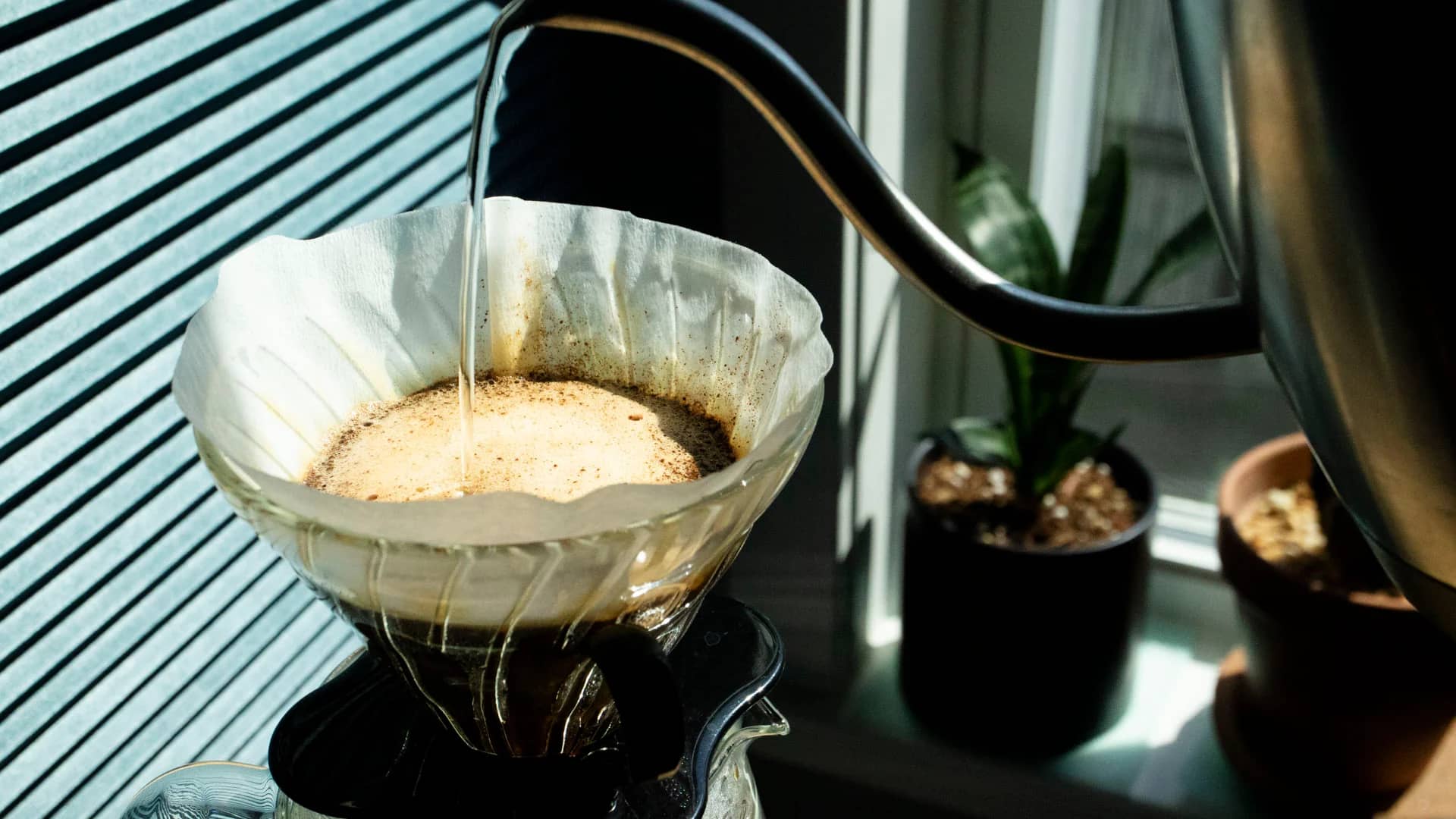
- Bloom: pour 30 g of water in a slow spiral. Start your timer. The grounds will swell and release CO₂, especially if the coffee was roasted within the past two weeks. Wait 30–45 seconds. A vigorous bloom means fresh beans.
- First pour: add water to 130 g total. Pour in slow, concentric circles from the centre outward, avoiding the filter walls. Keep the stream steady and thin. Aim to reach 130 g by the 1:00 mark.
- Second pour: add water to 250 g total. Continue pouring in the same spiral pattern. Aim to finish pouring by 1:45–2:00. Let the remaining water draw down through the bed.
- Total drawdown should finish between 2:30 and 3:30. If the brew finishes sooner, grind finer next time. If it takes longer, grind coarser. Swirl the server gently, pour, and taste.
This recipe produces a balanced cup that works for both light and medium roasts. For a stronger cup, increase the dose to 16–17 g while keeping water at 250 mL. This same setup also works for Japanese iced coffee, where you brew directly onto ice for a chilled cup that preserves Ethiopian coffee's bright acidity and floral complexity.
Region-by-Region Ethiopian Pour Over Recipes
Each Ethiopian coffee region has a distinct density, flavour profile, and typical processing method. The adjustments below build on the base recipe to bring out what each region does best. These are the recipes no generic pour over guide provides.
| Region | Typical Process | Grind Adjustment | Temp | Target Brew Time | What to Expect |
|---|---|---|---|---|---|
| Yirgacheffe | Washed | Slightly finer than base | 94–96 °C | 3:00–3:30 | Jasmine, lemon zest, bergamot; tea-like body with bright, sparkling acidity |
| Guji | Natural or washed | Slightly coarser for natural; base for washed | 93–95 °C | 2:30–3:15 | Blueberry, dark chocolate, peach; medium body with sweet, lingering finish |
| Sidamo | Washed or natural | Base setting | 93–95 °C | 2:45–3:15 | Stone fruit, brown sugar, mild citrus; balanced body with gentle acidity |
| Harar | Natural (dry-processed) | Slightly coarser than base | 92–94 °C | 2:30–3:00 | Wild blueberry, wine, dried fruit; heavy body with pronounced sweetness |
| Limu | Washed | Base to slightly finer | 93–95 °C | 2:45–3:15 | Honey, spice, mild floral; rounded body with soft sweetness |
Yirgacheffe Pour Over
Washed Yirgacheffe is the classic Ethiopian pour over coffee. Its high altitude (1,800–2,200 masl) produces an exceptionally dense bean that benefits from slightly finer grinding and hotter water. Push the temperature to 95–96 °C and aim for a longer 3:00–3:30 extraction. The reward is a cup with jasmine aromatics, lemon zest brightness, and a clean, almost tea-like finish. If you are new to Ethiopian pour over, start here.
Guji Pour Over
Guji produces both washed and natural lots. Natural Guji, with its intense blueberry and dark chocolate character, is best served by a slightly coarser grind and a marginally lower temperature (93–94 °C) to avoid extracting harshness from the fruit sugars on the bean surface. A washed Guji can handle the same settings as Yirgacheffe. In both cases, Guji rewards patience; let the drawdown finish completely before removing the dripper.
Harar Pour Over
Harar is always natural-processed and carries the wildest fruit notes of any Ethiopian region. Grind it coarser and lower the temperature to 92–94 °C. The goal is to maintain sweetness without pulling excessive bitterness from the dried-fruit layer. A faster brew time (2:30–3:00) keeps the cup lively. Harar pour over will taste like blueberry wine with a heavy, syrupy body; it is not for everyone, but for those who enjoy fruit-forward coffee, it is extraordinary.
Washed vs Natural Ethiopian Coffee in a Pour Over
Processing method changes your pour over technique more than most brewers realise. Here is the core difference and what to adjust.
Washed (wet-processed) Ethiopian coffee has had the fruit mucilage removed before drying. The result is a cleaner, brighter cup with more pronounced acidity. Washed beans are more uniform in density, so they extract evenly. Grind slightly finer and use higher water temperatures (94–96 °C). Washed coffees from Yirgacheffe and Limu are the most forgiving for pour over beginners.
Natural (dry-processed) Ethiopian coffee was dried inside the cherry, absorbing fruit sugars. The result is a sweeter, fruitier cup with a heavier body. Natural beans are less uniform in density, so they are more prone to uneven extraction. Grind slightly coarser, lower the temperature by 1–2 °C, and pour more slowly to compensate. Natural coffees from Guji and Harar shine in a pour over when you respect these adjustments.
For a deeper comparison of processing methods and their effects on flavour, see our washed vs natural Ethiopian coffee guide.
Common Pour Over Mistakes and How to Fix Them
| Problem | Likely Cause | Fix |
|---|---|---|
| Sour, thin, under-developed | Under-extraction (grind too coarse, water too cool, brew too fast) | Grind 1–2 clicks finer, raise temperature by 1–2 °C, pour more slowly |
| Bitter, harsh, astringent | Over-extraction (grind too fine, water too hot, brew too long) | Grind 1–2 clicks coarser, lower temperature, speed up your pour |
| Uneven or muddy flavour | Channelling from uneven coffee bed or erratic pouring | Level the bed before pouring; maintain a steady, concentric spiral |
| Brew drains too slowly (4+ min) | Grind too fine or too many fines clogging the filter | Grind coarser; consider upgrading your grinder for fewer fines |
| Flat, lifeless cup | Stale coffee (roasted more than 4–6 weeks ago) or stale water | Use beans within 2–4 weeks of roast date; use fresh, filtered water with balanced minerals |
| Papery or off taste | Filter not rinsed before brewing | Always rinse paper filters with hot water and discard the rinse |
Change only one variable at a time. If you adjust grind and temperature simultaneously, you will not know which change improved (or worsened) the cup. Keep a simple log of your settings and results until you find your sweet spot. Our tasting notes guide can help you articulate what you are tasting.
Water Quality for Canadian Home Brewers
Water is 98% of your finished cup. In Canada, municipal water quality varies significantly by city, and this directly affects extraction.
Hard water (Toronto, Calgary, much of the Prairies) contains higher mineral content, which accelerates extraction and can make Ethiopian coffee taste flat or chalky. If your water is hard, use a simple carbon filter (like a Brita) or bottled spring water with a total dissolved solids (TDS) reading between 75 and 150 ppm.
Soft water (Vancouver, parts of the Maritimes) extracts more slowly and may leave the cup tasting slightly sour or under-developed. Soft water works well for Ethiopian pour over in most cases, but if you consistently experience sourness, try a slightly finer grind or slightly higher temperature rather than changing your water.
The Specialty Coffee Association recommends brewing water with 150 mg/L of TDS (with a target range of 75–250 mg/L). Most filtered Canadian tap water falls within this range. Avoid distilled or reverse-osmosis water; coffee needs some mineral content to extract properly.
Frequently Asked Questions
Is Ethiopian coffee good for pour over?
Ethiopian coffee is widely considered the best single-origin choice for pour over. Its heirloom varieties, high-altitude density, and complex flavour compounds, from jasmine and citrus to blueberry and stone fruit, are best revealed by pour over's clean, controlled extraction. Most specialty cafés in Canada use pour over as the default method for Ethiopian beans.
What pour over ratio should I use for Ethiopian coffee?
Start with a 1:16.7 ratio (15 g of coffee to 250 mL of water). For a slightly stronger cup, try 1:15 (15 g to 225 mL). For a lighter, more tea-like cup, move to 1:17 (15 g to 255 mL). The ideal ratio depends on your beans, grinder, and personal preference; adjust by 5–10 mL of water per brew until you find your sweet spot.
Should I use a V60 or Chemex for Ethiopian coffee?
Both work well. The Hario V60 gives you the most control over flow rate and produces a lighter, more nuanced cup that showcases delicate floral notes. The Chemex uses a thicker filter that absorbs more oils, resulting in an even cleaner cup but slightly less body. For washed Ethiopian coffee, either works beautifully. For natural-process beans with heavy body, the V60 preserves more character.
What grind size for Ethiopian pour over?
Medium-fine, roughly the texture of table salt. Washed Ethiopian beans benefit from slightly finer grinding because their uniform density allows even extraction. Natural-process beans need slightly coarser grinding to prevent over-extraction of the fruit sugars. See our grind size guide for specific settings by grinder model.
How long should an Ethiopian coffee pour over take?
Total brew time, from bloom to final drip, should be 2:30 to 3:30 for a single 250 mL cup. Washed coffees tend toward the longer end (3:00–3:30) because finer grinds slow drawdown. Naturals tend toward the shorter end (2:30–3:00) because coarser grinds drain faster. If your brew consistently falls outside this range, adjust your grind size first.
Brew Ethiopian Coffee the Way It Deserves
Ethiopian coffee pour over is a method that rewards attention and repays every small improvement you make. Start with the base recipe, match your grind and temperature to the region and processing method you are brewing, and change one variable at a time. Within a few sessions, you will be pulling cups that rival what you pay $6 for at a specialty café.
At Ethiopian Beans, every bag we sell is sourced at origin through our family export company, Ethio Coffee Export, and shipped fresh across Canada. Every bag lists the region, processing method, and roast date, which means you can use the recipes in this guide with confidence, knowing exactly what is in your cup.
Premium Ethiopian Coffee, Shipped Fresh Across Canada
Every bag from Ethiopian Beans is sourced at origin through Ethio Coffee Export, our family export company in Ethiopia, and roasted to order in Canada.
You get real traceability, fast domestic shipping, and single-origin beans from regions like Yirgacheffe, Guji, Sidamo, Harar, and Limu.
Related Articles
Brewing & Preparation
Roast & Tasting
Regions & Varieties
About This Insight: Written by Ethiopian Beans, a Canadian coffee company sourcing at origin in Ethiopia through Ethio Coffee Export, our family export operation. Brewing recommendations are based on standard specialty coffee practices and testing across Ethiopian regions and processing methods. Individual results vary by bean lot, grind equipment, water quality, and personal preference. For the freshest results, use beans within 2–4 weeks of the roast date printed on your bag. Contact us at ethiopianbeans.ca/contact.